- Tactile Indicators
- 19, 11, 2025
Tactile floor indicators (TGSIs) help people with visual impairments navigate safely by signalling hazards and guiding movement. Proper placement is essential for safety, accessibility, and compliance.
What Are the Main Types of Tactile Floor Indicators?

Tactile floor indicators (TGSIs) come in different styles, each designed to support safe movement for people with visual impairments. Understanding the main types helps building owners choose the right accessibility flooring and meet installation guidelines.
Warning Tactile Indicators
Warning tactile indicators use raised studs to signal hazards like stairs, ramps, platform edges, and crossings. They tell pedestrians to stop or proceed with caution.
Directional Tactile Indicators
Directional tactile indicators use long bars to guide people along a safe path. They are used in corridors, entrances, open areas, and transport stations.
Integrated vs Surface-Applied Tiles
Integrated tiles are built into the floor and offer high durability for heavy-traffic areas.
Surface-applied tiles stick onto existing flooring and are quick, easy, and cost-effective for renovations and indoor spaces.
Key Places Where Tactile Indicators Must Be Installed
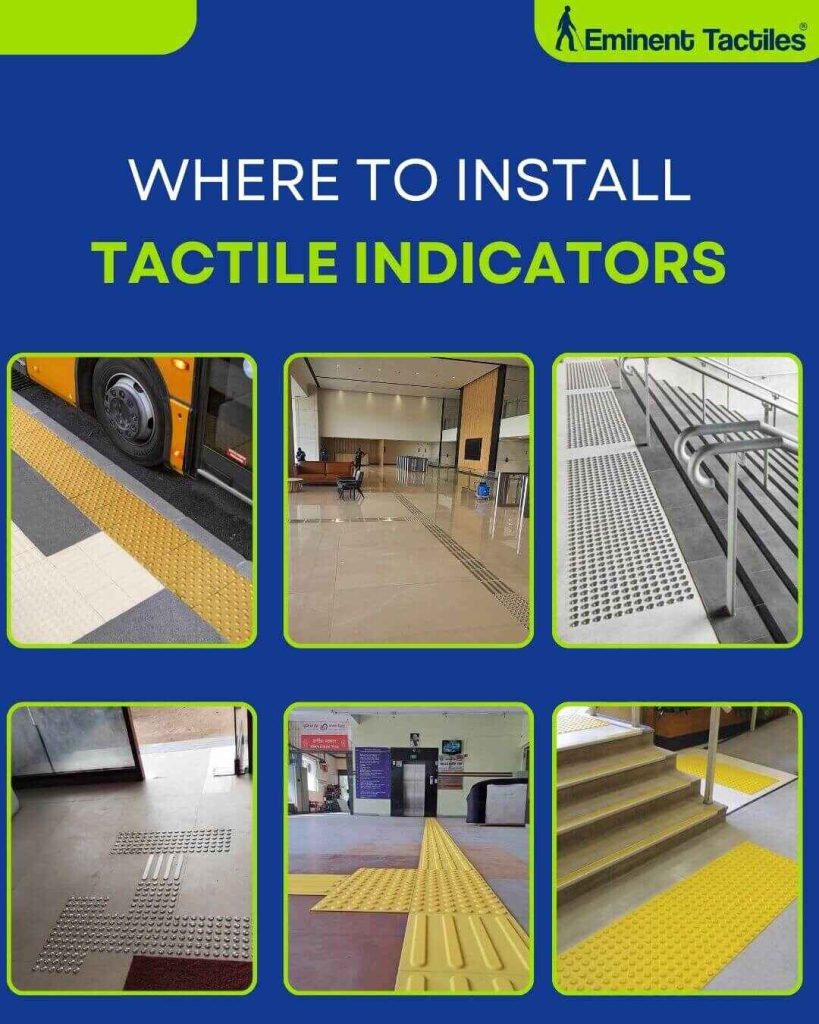
Tactile floor indicators (TGSIs) must be placed in key public areas where safety, guidance, and accessibility are required. Correct tactile indicator installation helps visually impaired users move confidently while ensuring buildings meet accessibility standards. Below are the 10 most important locations where tactile paving and tactile tiles should be installed.
1. Entrances and Building Access Points
Tactile indicators should be installed at public and commercial entrances to give users clear direction when entering or exiting a building. This helps create safe access routes and ensures the visually impaired can identify doorways, ramps, and lobby areas easily.
2. Staircases and Ramps
Warning tactile indicators must be placed at the top and bottom of staircases and ramps. These tiles signal a change in level and help prevent slips or falls. ADA tactile indicators also improve grip and safety on stair edges and inclined surfaces.
3. Pedestrian Crossings & Sidewalks
TGSIs are essential at road crossings, sidewalks, and kerbs. They alert pedestrians to traffic zones and help them identify safe crossing points. Consistent tactile paving on footpaths ensures unhindered movement for the visually impaired.
4. Railway Stations, Bus Stops & Transport Platforms
Transport hubs require tactile indicators for platform edge detection, especially near train tracks and bus loading zones. Directional tactile indicators also guide commuters toward ticket counters, exits, lifts, and pathways.
5. Shopping Centres, Malls & Retail Spaces
Tactile tiles help manage public movement in large retail environments. Integrated tactile tiles are ideal for high-traffic shopping malls because they offer long-lasting durability, strong visual contrast, and slip resistance.
6. Hospitals, Clinics & Healthcare Buildings
Healthcare locations must provide clear tactile pathways to help patients with visual impairments move safely. TGSIs at entrances, corridors, waiting areas, and lift lobbies support safe navigation in busy medical facilities.
7. Offices, Corporate Parks & Commercial Spaces
In commercial buildings, tactile indicators are installed in lobbies, reception areas, elevator zones, and common corridors. These placements ensure compliance with accessibility laws and improve safe movement for employees and visitors.
8. Schools, Colleges & Educational Campuses
Educational campuses use tactile paving to guide students through hallways, staircases, pathways, and entrances, ensuring safer routes across large open spaces.
9. Hotels, Resorts & Hospitality Areas
Hotels must install tactile floor indicators in reception zones, entries, pool areas, and access ramps to support inclusive guest movement and meet accessibility requirements.
10. Parking Areas, Drop-Off Zones & Building Exits
TGSIs placed at parking entrances, drop-off points, basement access, and emergency exits help visually impaired users move safely in high-risk and low-light areas.
TGSI Installation Guidelines: What Standards Should You Follow?
Proper installation of tactile floor indicators (TGSIs) is essential for safety, accessibility, and compliance. Following recognised standards ensures that tactile paving guides visually impaired users effectively and remains durable in public spaces. Here are the key TGSI installation guidelines every building should follow.
Follow ADA and International Accessibility Standards
Tactile indicators must meet requirements set by global accessibility codes, such as:
- ADA Standards (USA)
- AS/NZS 1428.4.1 (Australia & New Zealand)
- ISO 23599 International TGSI Standard
Common Installation Mistakes and How to Avoid Them
Here is a list of common installation mistakes:
- Incorrect spacing
- Low colour contrast
- Poor alignment
- Using the wrong material
- Installing on uneven or damaged surfaces
- Not cleaning or preparing the floor before installation
- Weak adhesive or poor fixing method
- Wrong placement location (not following TGSI standards)
- Inconsistent orientation of directional indicators
- Not checking slip-resistance ratings
- Using tiles without UV or weather protection (for outdoor areas)
- Mixing different styles or patterns that confuse users
Conclusion: Choosing the Right Tactile Tiles for Every Location
Tactile floor indicators (TGSIs) must be installed in key locations like entrances, stairs, ramps, crossings, platforms, malls, hospitals, and offices to ensure safe and accessible movement. Following proper installation guidelines—correct spacing, strong colour contrast, good alignment, and the right materials—is essential for compliance and user safety. Choosing durable, slip-resistant tactile tiles with high visibility ensures long-lasting performance and improves accessibility in every public space.
Tactile floor indicators help visually impaired people detect hazards, identify crossings, and follow safe walking routes in public and commercial spaces.
TGSIs must be installed at entrances, stairs, ramps, crossings, platforms, corridors, malls, hospitals, and high-traffic public areas to ensure safe navigation.
Warning indicators use raised studs to signal hazards, while directional indicators use raised bars to guide pedestrians along a defined path.
Installation must follow recognised standards such as ADA (USA), AS/NZS 1428.4.1 (Australia), and ISO 23599 for spacing, patterns, colour contrast, and slip resistance.
Select tiles based on location, durability, slip resistance, weather exposure, colour contrast, and compliance with accessibility requirements.
Stainless steel, polyurethane (PU), and ceramic tactile tiles are considered best due to durability, weather resistance, and strong visual contrast.
Incorrect spacing, weak adhesive, low contrast, poor alignment, and using the wrong type of tile for indoor or outdoor locations.
Yes. Surface-applied tactile tiles can be installed on existing concrete, tiles, granite, or marble using adhesive or mechanical fixing.
High contrast helps visually impaired users identify tactile surfaces quickly, especially in busy public areas or low-light environments.

offer now at
Our Clients