
- Tactile Indicators
- 19, 01, 2026
When people think of smart cities, they imagine tech-driven systems like traffic sensors, data platforms, and connected services. While these tools improve efficiency, they often dominate planning, and the real experience of moving through the city is ignored. This is where smart city accessibility products become essential. A city can be digitally advanced but still unsafe or hard to navigate if streets, crossings, transport hubs, and public spaces are not designed with accessibility in mind.
This is why smart cities must combine technology with human-centered, accessible infrastructure. As cities grow, the needs of seniors, people with disabilities, parents with prams, and visitors become more complex. Accessibility products in daily infrastructure help people move safely and independently. Without physical access, even the best digital systems fail to support real users.
What Are Smart City Accessibility Products?
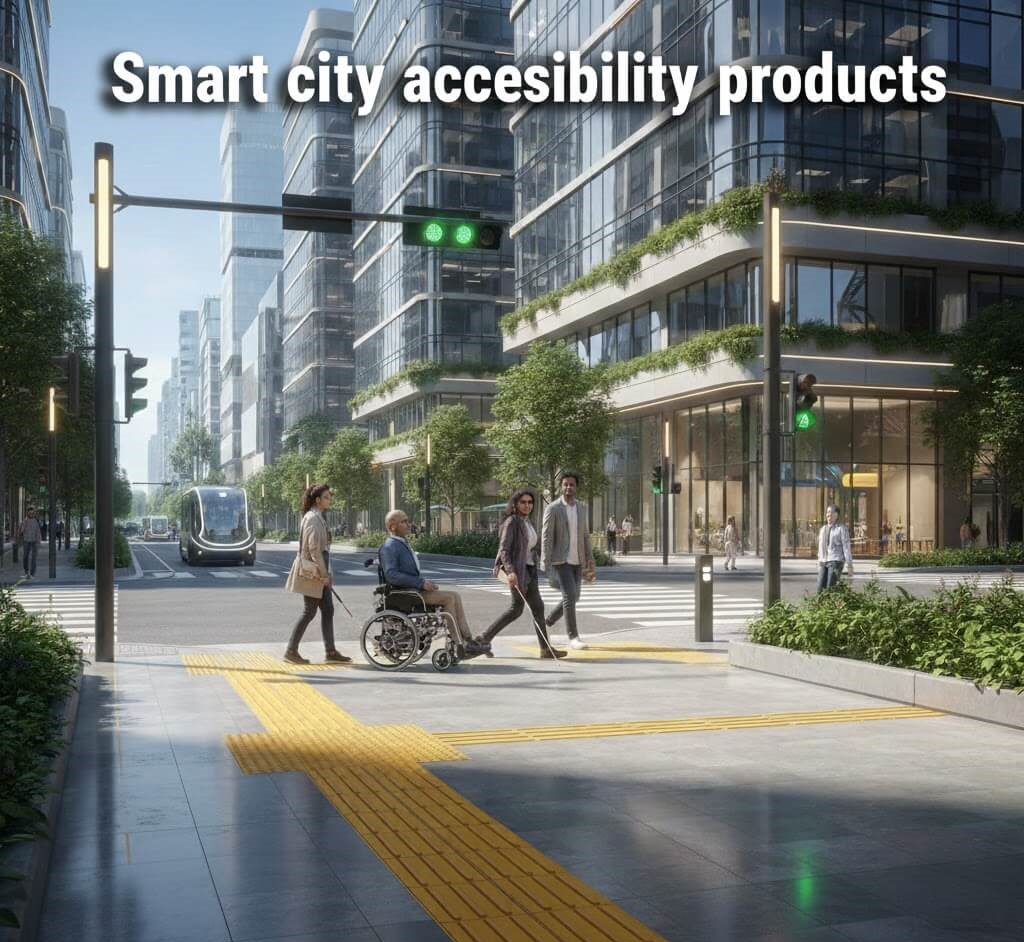
Accessibility products for smart cities are physical infrastructure elements that enable safe, independent movement in public spaces. Tactile indicators guide pedestrians with textured patterns, warning of hazards on footpaths, ramps, transport platforms, entrances, and crossings. They work without electricity, support inclusive urban design, enhance accessible transport systems, and improve daily mobility for seniors, disabled users, children, and visitors.
How They Differ from Traditional Accessibility Features
Traditional accessibility features are often added after construction, working in isolation and treating accessibility as compliance. In smart cities, tactile indicators and accessibility products are integrated from the start into universal design infrastructure, aligning with pedestrian safety systems and accessible urban transport, making them active parts of inclusive smart city mobility.
Why Accessibility Matters in Smart Cities
Safety and Independent Mobility
Accessibility is vital for public safety infrastructure in urban environments. Clear paths, safe crossings, and effective guidance systems prevent accidents in busy areas like intersections, transport hubs, and commercial zones. Well-planned accessible urban infrastructure supports independence, reduces injuries, and enhances smart mobility solutions by enabling predictable and safer pedestrian movement.
Supports Ageing and Diverse Populations
Smart cities must be designed for all ages and abilities, not just tech-savvy users. Accessible urban infrastructure ensures elderly citizens, people with temporary injuries, parents with prams, and tourists can navigate safely. Clear pathways, smooth surfaces, and intuitive layouts improve urban mobility systems, reduce accidents, and enhance independence, making cities safer, inclusive, and easy to use for everyone.
Compliance and Risk Reduction for Authorities
From a planning perspective, investing in accessible urban infrastructure is a smart risk-management strategy. Early integration of smart mobility solutions reduces legal issues, prevents accidents, avoids costly retrofitting, and ensures safer, efficient, and inclusive public spaces, boosting citizen satisfaction and supporting sustainable smart city development.
Common Accessibility Challenges in Urban Environments
Many cities face urban mobility challenges where poorly designed streets, crossings, and sidewalks reduce pedestrian safety in smart cities. Fixing these barriers ensures accessible transport systems.
Common problems planners face include:
- Confusing pedestrian routes that change suddenly or lack clear direction
- Unsafe platform edges and crossings that increase the risk of falls and accidents
- Inconsistent sidewalk layouts with uneven surfaces, steps, or blocked paths
- Information overload in public spaces, where too many signs and screens cause confusion
- Poor guidance in large transport hubs like stations and terminals, where people struggle to find exits, platforms, or services
Smart City Accessibility Products Used in Public Infrastructure
Smart cities use accessibility products to create safe, intuitive, and easy-to-navigate public spaces. Products like tactile indicators guide pedestrians and support smart monitoring systems, improving flow, safety, and efficiency in urban mobility systems.
Public Transport Accessibility Systems
- Platform safety solutions prevent accidents near train, metro, or bus platforms.
- Boarding guidance systems assist passengers with wheelchairs, strollers, or visual impairments.
- Station navigation aids make it easier for users to find exits, platforms, and services, improving overall accessible public transport infrastructure.
Intelligent Pedestrian Crossing Solutions
- Create safer crossing flow for all users, including mobility-impaired pedestrians.
- Support predictable movement patterns, which can be integrated with smart pedestrian crossings and city monitoring systems.
Public Building Access Solutions
- Provide entry-level navigation support at entrances for smooth access.
- Offer corridor and exit guidance, ensuring safe movement inside complex buildings.
- Connect with wayfinding systems for cities, linking indoor and outdoor navigation to create a seamless accessibility experience.
How Accessibility Products Support Smart Tech Systems
In smart cities, IoT smart city infrastructure relies on safe, predictable movement. Tactile ground surface indicators guide pedestrians, supporting urban mobility systems and AI traffic management. Structured flow improves sensor accuracy, enhances human-centred smart city design, and boosts overall city efficiency.
A structured and safe pedestrian flow enhances smart crossings, automated traffic systems, and accessible transport infrastructure, reducing congestion and accidents. Using tactile indicators and other inclusive urban design products improves data accuracy, making human-centred smart city design more effective. Predictable movement allows technology to optimize signals, enhance public safety, and connect physical guidance with IoT smart city infrastructure.
Why Smart Cities Struggle with Accessibility
Despite smart city growth, many cities face accessibility issues. Proper planning avoids smart city planning mistakes and ensures inclusive urban infrastructure.
Accessibility Added After Construction
When accessibility features are added after construction, they often create patchwork solutions. Installing tactile indicators only in select areas leaves gaps in urban mobility, reducing pedestrian safety in smart cities and making navigation unsafe for people with disabilities or mobility challenges.
Over-Focus on Digital Solutions
Relying heavily on apps, sensors, or automated guidance cannot replace physical accessibility products. Without proper tactile surfaces, safe crossings, and consistent wayfinding, even the most advanced digital systems fail to guide people effectively through public spaces.
Accessibility Seen Only as Compliance
Treating accessibility as just a legal requirement limits its real impact on citizens. Meeting compliance alone often ignores usability and safety, putting the elderly, disabled, and visitors at risk. Planning from the start with tactile indicators and accessible urban infrastructure ensures truly inclusive smart city design.
Benefits of Early Accessibility Planning
Integrating accessibility products like tactile ground surface indicators from the start of smart city projects ensures safe, efficient, and inclusive urban infrastructure, improving smart mobility and reducing costs.
- Lower Lifetime Project Costs
- Faster Public Acceptance of Smart Services
- Reduced Accident Claims
- Higher Infrastructure Efficiency
- Better Social Inclusion Metrics
- Improved Compliance with Accessibility Standards
- Enhanced Urban Mobility Experience Supports Smart City Data Accuracy
- Long-Term Sustainability
- Positive Public Image for the City
Future Trends in Smart City Accessibility Products
The future of smart city accessibility is shifting to AI-driven, human-centered solutions. Products like tactile indicators(TGSIs) integrate with urban infrastructure for safer, smarter, and inclusive cities.
- Data-Driven Pedestrian Safety Planning – Cities will use data from sensors, IoT devices, and accessibility infrastructure to analyze movement patterns and optimize safe routes for all users.
- Predictive Maintenance of Accessibility Infrastructure – Smart systems will track wear and damage in products like tactile indicators, ensuring timely maintenance before hazards develop.
- Global Shift Toward Universal Design Standards – Governments and planners adopt universal design to make smart city accessibility products safe, standard, and usable.
- Enhanced Human-Centered Urban Design – Future accessibility solutions will focus on the experience of all citizens, including elderly users, people with disabilities, tourists, and children.
- Next-Generation Accessibility Solutions – Smart city accessibility products like tactile indicators boost safety, urban mobility, and inclusive infrastructure.
- Sustainable and Cost-Efficient Urban Planning – Early integration of these solutions reduces long-term retrofitting costs while improving social inclusion metrics.
Conclusion
Smart city accessibility products, including tactile indicators, are essential for human-centered smart city infrastructure. They ensure safe, independent movement, support urban mobility systems, improve AI traffic and sensor performance, reduce long-term costs, and enhance public trust. Integrating accessibility from planning creates inclusive, resilient, and sustainable smart cities for all citizens.
Accessibility products create predictable pedestrian movement, reducing congestion and improving traffic flow. Structured pathways allow sensors, AI traffic systems, and smart monitoring tools to collect more accurate data, improving signal timing, safety automation, and overall urban efficiency while keeping pedestrians safe and independent.
Tactile indicators provide physical guidance and hazard warnings directly on walking surfaces. They work without electricity or devices, making them reliable in all conditions. In smart cities, they support inclusive mobility, improve pedestrian safety, and integrate with smart monitoring systems for better movement planning.
No. Digital tools like apps and sensors cannot replace physical accessibility infrastructure. Without tactile paving, safe crossings, and consistent pathways, people with visual impairments, elderly users, and visitors may struggle to navigate safely, even in highly connected smart cities.
Accessibility products should be integrated during the planning and design stage, not added later. Early integration reduces construction costs, avoids retrofitting, improves compliance, and ensures safer pedestrian flow while supporting smart city data accuracy and operational efficiency.
Transport hubs, sidewalks, pedestrian crossings, public buildings, healthcare facilities, schools, commercial zones, and transit platforms benefit the most. These high-traffic environments require predictable navigation, hazard warnings, and safe movement for diverse users.
Yes. Accessible infrastructure improves safety and independence for elderly citizens by providing stable surfaces, clear guidance, and predictable movement patterns. This reduces fall risks, improves confidence in public mobility, and supports long-term urban inclusivity.
Early adoption helps cities meet accessibility regulations, prevent accidents, reduce liability claims, and avoid expensive retrofitting. Well-designed accessibility infrastructure also improves public satisfaction and long-term asset performance.
Yes. Tactile indicators are designed for sidewalks, crossings, platforms, entrances, corridors, and public buildings. Materials vary based on environment, ensuring durability, slip resistance, and long-term performance indoors and outdoors.
They extend infrastructure lifespan, reduce accident-related costs, minimize maintenance issues through predictive planning, and support inclusive urban growth. Sustainable accessibility improves social equity while optimizing operational efficiency.
Future systems will combine AI analytics, IoT sensors, predictive maintenance, universal design standards, and human-centered planning to improve safety, movement efficiency, and long-term infrastructure sustainability.
- What Are Smart City Accessibility Products?
- Why Accessibility Matters in Smart Cities
- Common Accessibility Challenges in Urban Environments
- Smart City Accessibility Products Used in Public Infrastructure
- How Accessibility Products Support Smart Tech Systems
- Why Smart Cities Struggle with Accessibility
- Benefits of Early Accessibility Planning
- Future Trends in Smart City Accessibility Products
- Conclusion

offer now at
Our Clients